Walk into a wood, any wood. What impresses itself? The trees, naturally; they cast shadows and throw down leaves and acorns, while a woodpecker hammers and – if you’re lucky – a weasel nips across the path. Life is everywhere, leaking sap and uttering alarm cries. But it all stands on a thin foundation of white threads.

Those threads are fungi – the actual fungus organism, existing in a fine mesh in soil or wood. In autumn, those threads send up their fruit.

Fungi grow trees. Many species bind their hyphae (the technical term for the white threads) into relationships with roots, helping the tree absorb water and nutrients. No fungi, no woods; or at least, much weaker and more disease-prone trees. So significent are fungi for tree planters that the mycorrhizal species are now on the commercial market. A world without fungi would be so different that it is hard to contemplate it.

Fly agaric (of the famous red and white spots) often befriends birches, and in autumn the fungus encircles its tree with garish fruit bodies.
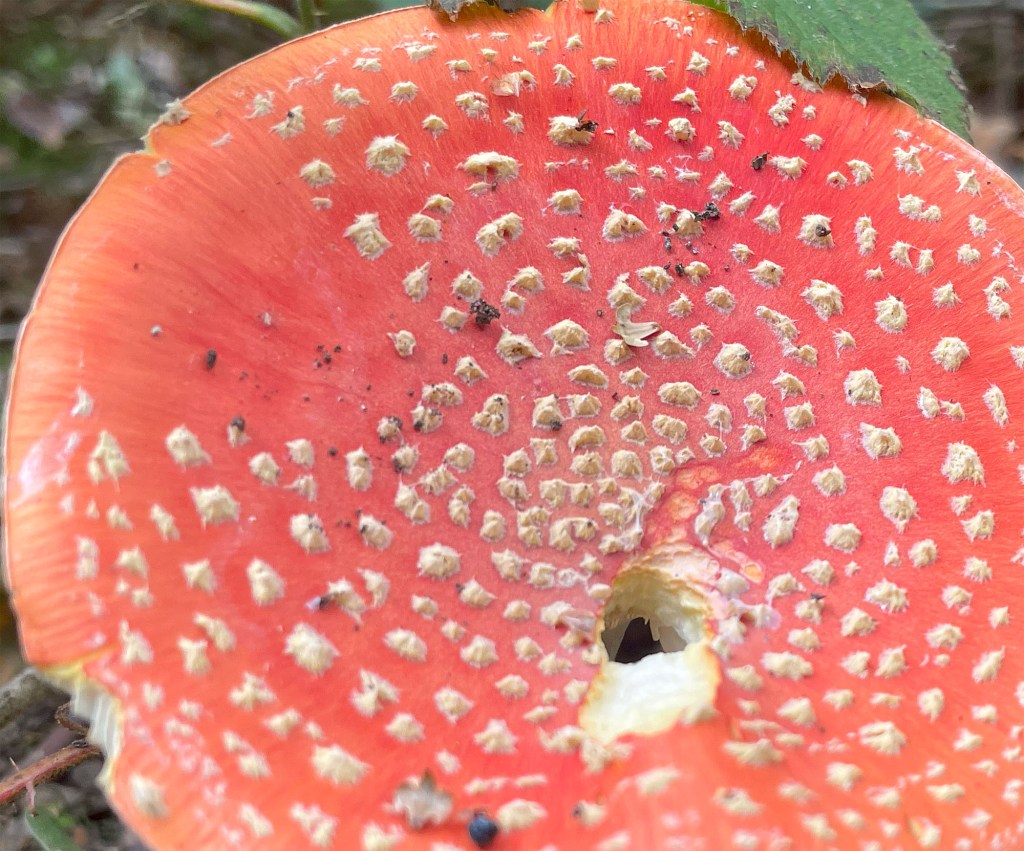
Its family name is Amanita, a byword for “admire from afar”. The fly agaric contains psychoactive compounds, but just across the wood lurks a sinister cousin.

Yes, that is a death cap Amanita phalloides. Sickly green and sitting in its broken white cup. Although, as humans, we tend to be mostly interested in why it should never be eaten, from a purely ecological point of view it exists in a mutual relationship with oak trees. The king of trees is thus held aloft by the world’s most infamous fungus.

But while some fungi grow new trees, others clean up the dying. This is hen-of-the-woods, which may either be a pathogen (an attacker of healthy trees) or a sapophyte (a rotter of decaying wood) depending on who you ask.
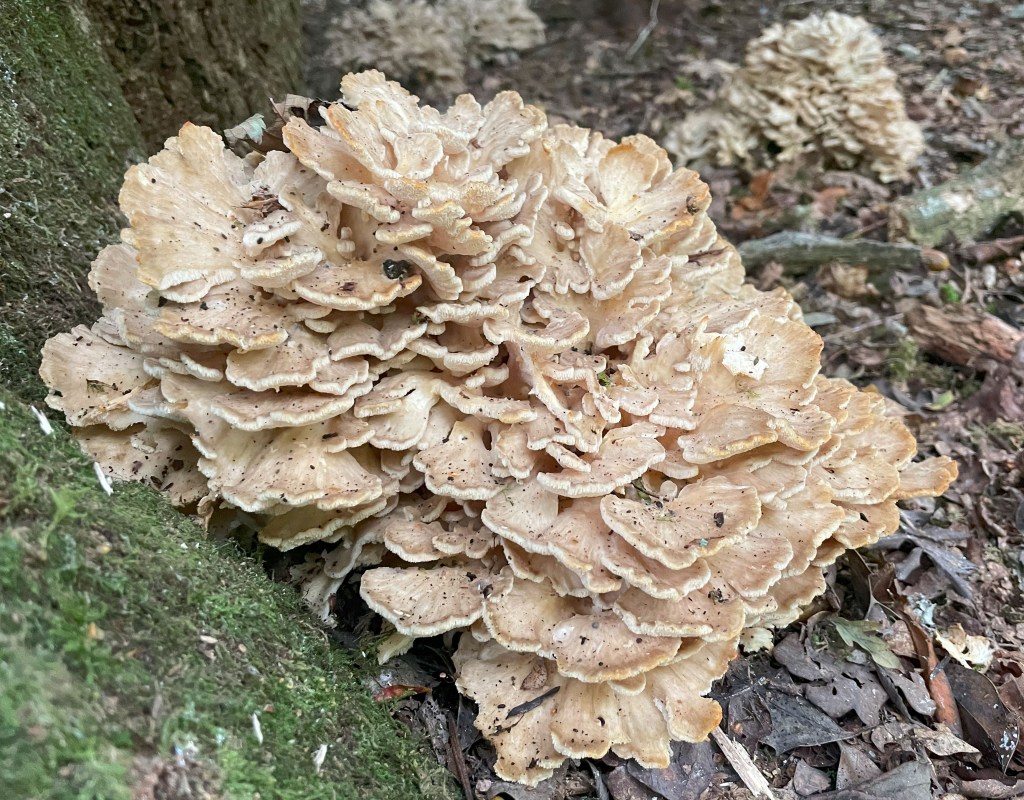
Learning all the ways of fungi would take many lifetimes. We walk in the woods they build.

And that should give us pause about the interconnectedness of the wild.

16 responses to “Woven in White”

  1. Thank you very much for this lyrical post about fungi, Adele. Yes, everything is connected, something that humans still have trouble understanding, even though it’s continuously proven.

    Liked by 2 people

    1. Thank you Lynette, and apologies for the late reply! Nature is amazingly, wonderfully complicated.

      Liked by 1 person

  2. There’s such a huge variety of fungi out there. A bit like a flower garden, but of a different type.

    Liked by 2 people

  3. Fascinating post. 🍄

    Liked by 1 person

    1. Thanks Paul – hope all’s well on the south coast. I expect there are even more fungi out now after the recent rain.

      Like

  4. Forests are teaming with life. The older I get, the more I understand it.

    Liked by 1 person

    1. Indeed, as are grasslands, bogs and mountains – and the sea of course. We live on a very complicated planet despite human endeavours to damage it.

      Like

  5. Great timing Adele. I just went hiking in the woods yesterday and found an abundance of mushrooms. I find the fascinating but don’t know their names like you do.

    Liked by 1 person

    1. Hi Brad, hope all’s well with you. I’ve been busy over the summer but am hoping to blog a bit more now we’re in autumn.

      Well, I know some of them – many others are still a mystery! A difficult group to identify and study but so interesting.

      Liked by 1 person

      1. Yes Adele. They’re very interesting. I could get an app to identify them but I’m mostly happy just visiting and taking photos.

        Like

  6. Wonderful photos, Adele. We really do owe our existence to mycorrhizal fungi. Along with water, it is the basis of life! 🍄

    Liked by 1 person

    1. Thank you Eliza. Life would certainly look very different without fungi.

      Liked by 1 person

  7. Comment. Please post. (Online form wouldn’t accept it.)

    Another excellent post! And so great to learn about a creature whose broad white fabric matrix undergirds everything in the forest, while seeming a somewhat random growth above ground. Thank you!

    Liked by 1 person

    1. Thank you Bridget. (Your comment seems to have posted okay?)

      Fungi are one of the strangest and most important forms of life.

      Like

Leave a reply to wordsfromanneli Cancel reply

Trending